
ROLI, Kings Cross Activation
Designing an end-to-end creative direction for an immersive live music pop-up in King's Cross Station.
Tech, Music, Spatial
Services
Role Overview
Creative Direction
Strategy & Brand Alignment
ROLI, Kings Cross Activation
Designing an end-to-end creative direction for an immersive live music pop-up in King's Cross Station.
Tech, Music, Spatial
Services
Role Overview
Creative Direction
Strategy & Brand Alignment
ROLI, Kings Cross Activation
Designing an end-to-end creative direction for an immersive live music pop-up in King's Cross Station.
Tech, Music, Spatial
Services
Role Overview
Creative Direction
Strategy & Brand Alignment

Overview
The brief was to build brand awareness for their music learning product in a way that felt native to the space, earned attention rather than demanded it, and generated shareable social content without feeling engineered.
King's Cross Station was the chosen venue: one of London's highest-footfall public spaces, architecturally striking, and culturally loaded. The space set a high bar. The design had to meet it.
My job was to translate ROLI's playful, approachable brand personality into a physical environment that felt surprising, memorable, and distinctly theirs — while navigating a complex venue, a multi-partner production, and a tight window for on-site delivery.
Film/ Photography: Hue Media
Build: Undercover Arts
Brand Awareness
Activation
Merch
2-week hard deadline

Concept
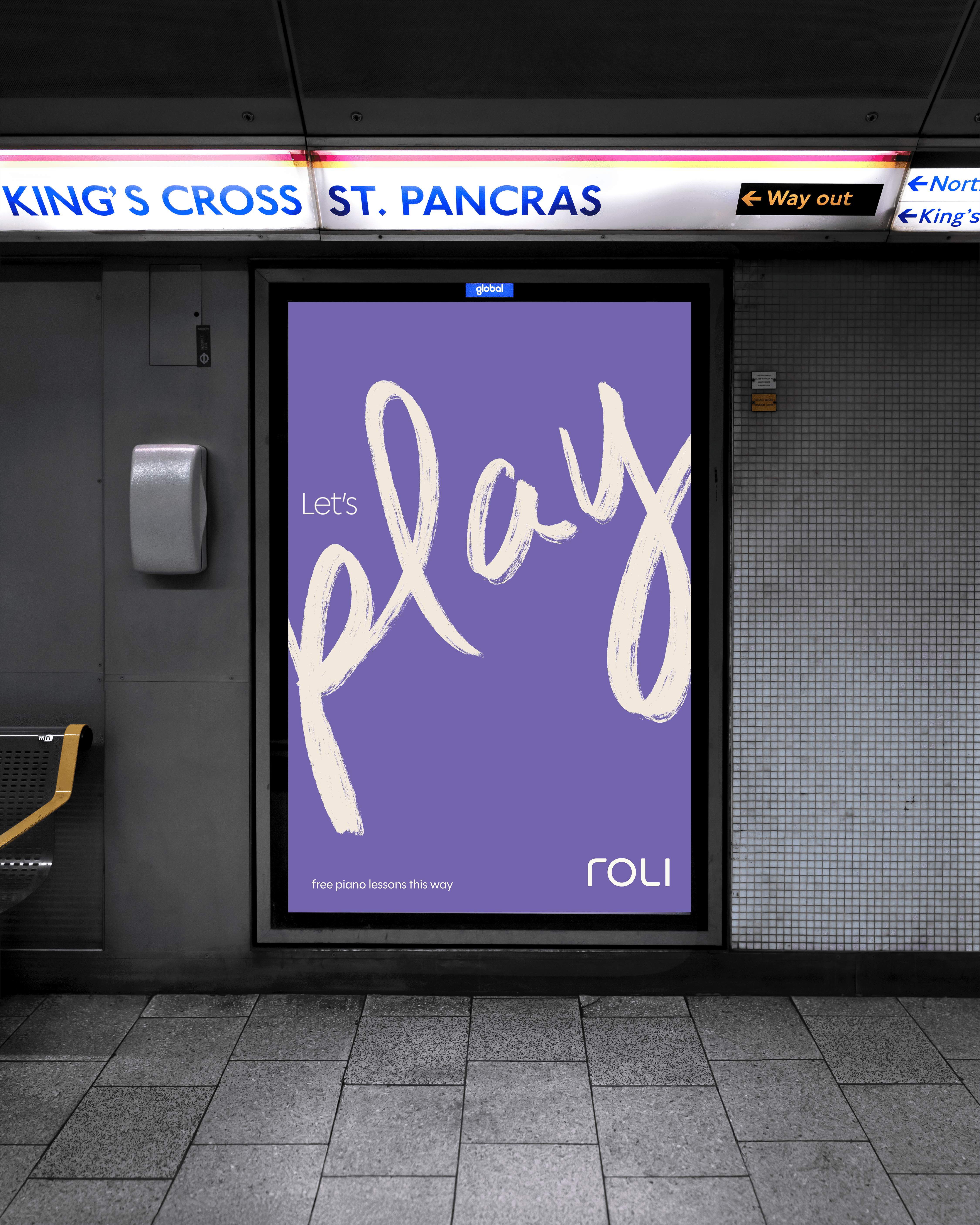
Spontaneous piano performances in public spaces were generating viral traction across social media. Rather than manufacturing a moment from scratch, we designed around one — giving it a ROLI frame.
The centrepiece was a grand piano with a hole cut into its lid, the interior replaced with ROLI's product. An unexpected, tactile interaction that stopped people mid-commute, invited engagement, and created an instinctive shareable moment.
Goals:
Build brand awareness through a physical environment people would stop for, interact with, and share.
Translate ROLI's playful personality into a space that matched the grandeur of King's Cross without losing the brand's irreverence.
Create assets and takeaways that extended the experience beyond the station and into social feeds.
Constraints and Trade offs
01 TFL Venue Regulations
King's Cross is a working station. Every design and build decision required TfL approval — restricting what could be fixed to floors and walls, setting noise and access limits, and dictating installation windows. I worked alongside the external agency managing the TfL relationship to ensure the creative vision stayed intact while remaining fully compliant.
02 Holding brand personality in a large space
The station's architecture is imposing. Too deferential and the activation disappears; too loud and it feels out of place. The design had to be confident enough to hold its own — using the grandeur of the space rather than fighting it — while keeping ROLI's cheekiness legible.
03 Aligning creative and social strategy in parallel
The activation was designed to function as a social moment as much as a physical one. That meant the creative direction and influencer strategy had to be developed in tandem — the space needed to be camera-ready, the interactions shareable by design, not retrofitted for content after the fact.
04 Maintaining creative control through a split build
With an external agency handling TfL logistics and the physical build, the risk was losing creative coherence in translation. I maintained full sign-off on every element — from the piano installation to the printed takeaways — to ensure the executed space matched the concept, not just approximately, but exactly.
05 Adapting quickly when things go wrong
With no practice run and a 4am build and take down. There was a high risk of at least one element not printing as intending. Below shows one such error. As a contingency I had a few sticky vinyls printed that could be used to cover any errors.


Production
I led production across every workstream simultaneously: spatial design and graphics, merchandise, printed collateral, motion assets for screens, and on day shoot logistics. I managed this using Notion to build support systems and Granola to document key decisions that could be agentically turned into tasks, keeping all parties in the loop.
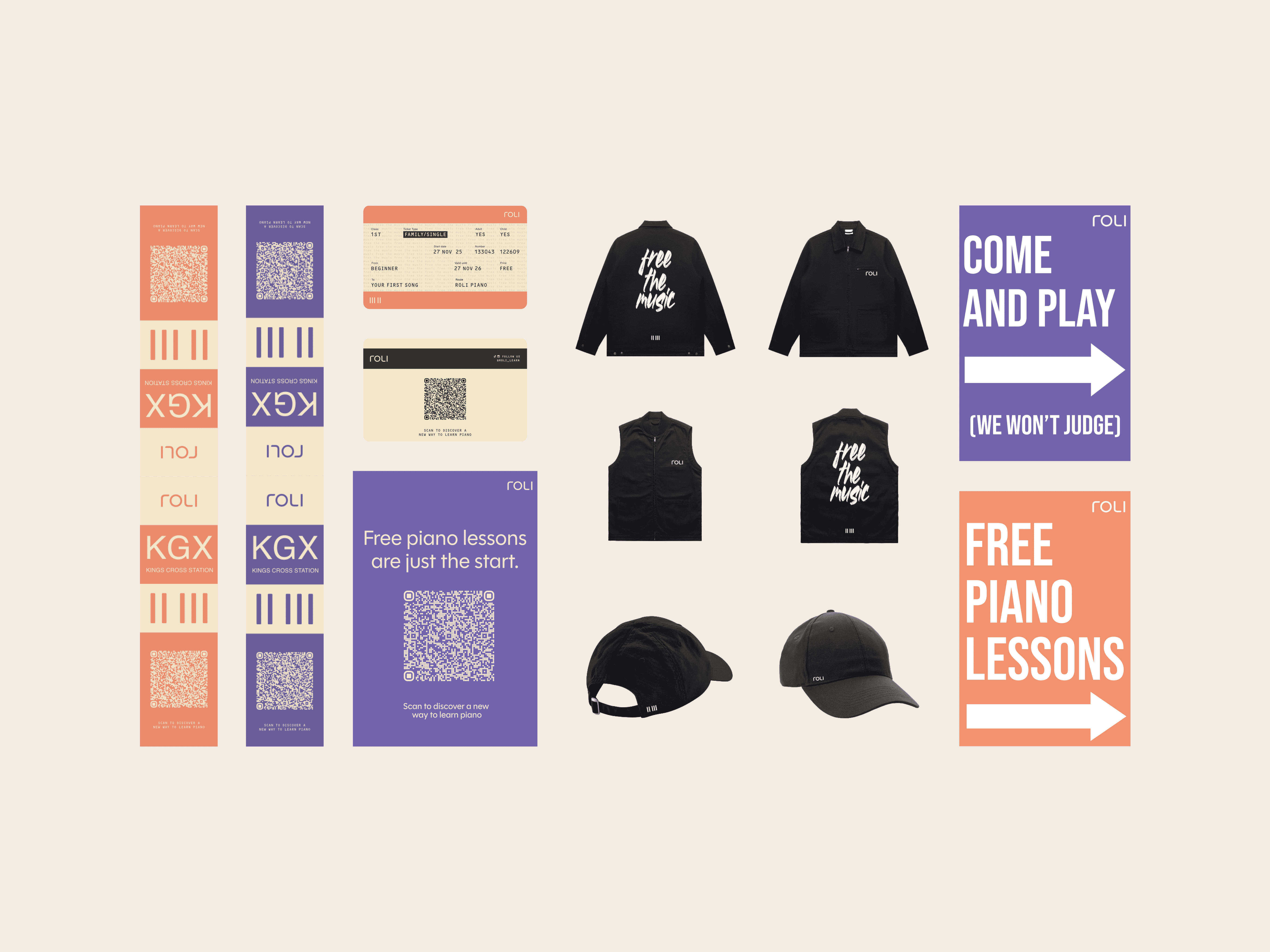
For print, I coordinated across multiple suppliers — signage, large-format environmental graphics, leaflets, and a set of playful branded takeaways designed to leave the station in people's pockets: train tickets, luggage tags, and branded merch. Each supplier was briefed with final files and specs; I managed amend cycles and approvals directly.
For the build, I worked closely with the external agency to translate the spatial design into installation reality — reviewing site surveys, signing off on material choices, and attending the build to direct on-site. Nothing was handed off with the expectation that someone else would make the calls.
Brand photography was coordinated with Hue Media. Shot planning, location sourcing within the station, and on-day direction were all part of my remit. Whilst the production agency managed influences and talent.

Result
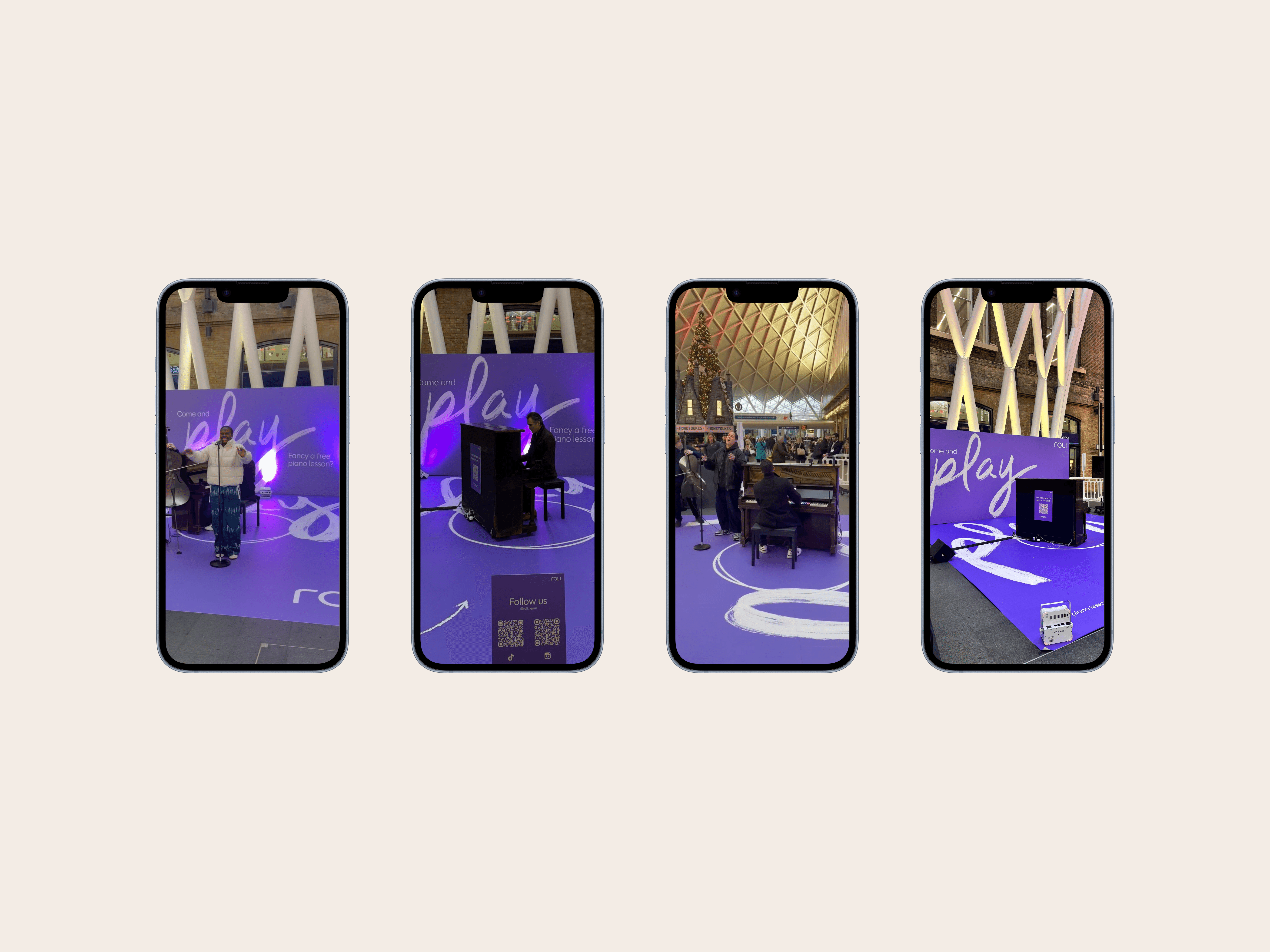
The station plot was transformed into a fully branded touch point:
environmental graphics, directional signage, a centrepiece grand piano installation, and a branded surround that made the space immediately legible as ROLI's, even to someone walking past at commuter pace.
The piano installation was the anchor. Cutting the lid and installing ROLI's product inside turned a passive object into an interactive invitatio , people stopped, played, photographed, and posted.
The interaction was designed to be instinctive: no instructions needed.
Branded takeaways
Train tickets, luggage tags, leaflets extended the experience past the exit. Everything was produced to the same quality standard as the main spatial graphics; nothing felt like an afterthought.
Influencer collaborators were briefed on the space and the moment, with the activation designed to give them something genuinely worth sharing rather than a staged setup.
Overview
The brief was to build brand awareness for their music learning product in a way that felt native to the space, earned attention rather than demanded it, and generated shareable social content without feeling engineered.
King's Cross Station was the chosen venue: one of London's highest-footfall public spaces, architecturally striking, and culturally loaded. The space set a high bar. The design had to meet it.
My job was to translate ROLI's playful, approachable brand personality into a physical environment that felt surprising, memorable, and distinctly theirs — while navigating a complex venue, a multi-partner production, and a tight window for on-site delivery.
Film/ Photography: Hue Media
Build: Undercover Arts
Brand Awareness
Activation
Merch
2-week hard deadline
Concept
Spontaneous piano performances in public spaces were generating viral traction across social media. Rather than manufacturing a moment from scratch, we designed around one — giving it a ROLI frame.
The centrepiece was a grand piano with a hole cut into its lid, the interior replaced with ROLI's product. An unexpected, tactile interaction that stopped people mid-commute, invited engagement, and created an instinctive shareable moment.
Goals:
Build brand awareness through a physical environment people would stop for, interact with, and share.
Translate ROLI's playful personality into a space that matched the grandeur of King's Cross without losing the brand's irreverence.
Create assets and takeaways that extended the experience beyond the station and into social feeds.
Constraints and Trade offs
01 TFL Venue Regulations
King's Cross is a working station. Every design and build decision required TfL approval — restricting what could be fixed to floors and walls, setting noise and access limits, and dictating installation windows. I worked alongside the external agency managing the TfL relationship to ensure the creative vision stayed intact while remaining fully compliant.
02 Holding brand personality in a large space
The station's architecture is imposing. Too deferential and the activation disappears; too loud and it feels out of place. The design had to be confident enough to hold its own — using the grandeur of the space rather than fighting it — while keeping ROLI's cheekiness legible.
03 Aligning creative and social strategy in parallel
The activation was designed to function as a social moment as much as a physical one. That meant the creative direction and influencer strategy had to be developed in tandem — the space needed to be camera-ready, the interactions shareable by design, not retrofitted for content after the fact.
04 Maintaining creative control through a split build
With an external agency handling TfL logistics and the physical build, the risk was losing creative coherence in translation. I maintained full sign-off on every element — from the piano installation to the printed takeaways — to ensure the executed space matched the concept, not just approximately, but exactly.
05 Adapting quickly when things go wrong
With no practice run and a 4am build and take down. There was a high risk of at least one element not printing as intending. Below shows one such error. As a contingency I had a few sticky vinyls printed that could be used to cover any errors.
Production
I led production across every workstream simultaneously: spatial design and graphics, merchandise, printed collateral, motion assets for screens, and on day shoot logistics. I managed this using Notion to build support systems and Granola to document key decisions that could be agentically turned into tasks, keeping all parties in the loop.
For print, I coordinated across multiple suppliers — signage, large-format environmental graphics, leaflets, and a set of playful branded takeaways designed to leave the station in people's pockets: train tickets, luggage tags, and branded merch. Each supplier was briefed with final files and specs; I managed amend cycles and approvals directly.
For the build, I worked closely with the external agency to translate the spatial design into installation reality — reviewing site surveys, signing off on material choices, and attending the build to direct on-site. Nothing was handed off with the expectation that someone else would make the calls.
Brand photography was coordinated with Hue Media. Shot planning, location sourcing within the station, and on-day direction were all part of my remit. Whilst the production agency managed influences and talent.
Result
The station plot was transformed into a fully branded touch point:
environmental graphics, directional signage, a centrepiece grand piano installation, and a branded surround that made the space immediately legible as ROLI's, even to someone walking past at commuter pace.
The piano installation was the anchor. Cutting the lid and installing ROLI's product inside turned a passive object into an interactive invitatio , people stopped, played, photographed, and posted.
The interaction was designed to be instinctive: no instructions needed.
Branded takeaways
Train tickets, luggage tags, leaflets extended the experience past the exit. Everything was produced to the same quality standard as the main spatial graphics; nothing felt like an afterthought.
Influencer collaborators were briefed on the space and the moment, with the activation designed to give them something genuinely worth sharing rather than a staged setup.
Overview
The brief was to build brand awareness for their music learning product in a way that felt native to the space, earned attention rather than demanded it, and generated shareable social content without feeling engineered.
King's Cross Station was the chosen venue: one of London's highest-footfall public spaces, architecturally striking, and culturally loaded. The space set a high bar. The design had to meet it.
My job was to translate ROLI's playful, approachable brand personality into a physical environment that felt surprising, memorable, and distinctly theirs — while navigating a complex venue, a multi-partner production, and a tight window for on-site delivery.
Film/ Photography: Hue Media
Build: Undercover Arts
Brand Awareness
Activation
Merch
2-week hard deadline
Concept
Spontaneous piano performances in public spaces were generating viral traction across social media. Rather than manufacturing a moment from scratch, we designed around one — giving it a ROLI frame.
The centrepiece was a grand piano with a hole cut into its lid, the interior replaced with ROLI's product. An unexpected, tactile interaction that stopped people mid-commute, invited engagement, and created an instinctive shareable moment.
Goals:
Build brand awareness through a physical environment people would stop for, interact with, and share.
Translate ROLI's playful personality into a space that matched the grandeur of King's Cross without losing the brand's irreverence.
Create assets and takeaways that extended the experience beyond the station and into social feeds.
Constraints and Trade offs
01 TFL Venue Regulations
King's Cross is a working station. Every design and build decision required TfL approval — restricting what could be fixed to floors and walls, setting noise and access limits, and dictating installation windows. I worked alongside the external agency managing the TfL relationship to ensure the creative vision stayed intact while remaining fully compliant.
02 Holding brand personality in a large space
The station's architecture is imposing. Too deferential and the activation disappears; too loud and it feels out of place. The design had to be confident enough to hold its own — using the grandeur of the space rather than fighting it — while keeping ROLI's cheekiness legible.
03 Aligning creative and social strategy in parallel
The activation was designed to function as a social moment as much as a physical one. That meant the creative direction and influencer strategy had to be developed in tandem — the space needed to be camera-ready, the interactions shareable by design, not retrofitted for content after the fact.
04 Maintaining creative control through a split build
With an external agency handling TfL logistics and the physical build, the risk was losing creative coherence in translation. I maintained full sign-off on every element — from the piano installation to the printed takeaways — to ensure the executed space matched the concept, not just approximately, but exactly.
05 Adapting quickly when things go wrong
With no practice run and a 4am build and take down. There was a high risk of at least one element not printing as intending. Below shows one such error. As a contingency I had a few sticky vinyls printed that could be used to cover any errors.
Production
I led production across every workstream simultaneously: spatial design and graphics, merchandise, printed collateral, motion assets for screens, and on day shoot logistics. I managed this using Notion to build support systems and Granola to document key decisions that could be agentically turned into tasks, keeping all parties in the loop.
For print, I coordinated across multiple suppliers — signage, large-format environmental graphics, leaflets, and a set of playful branded takeaways designed to leave the station in people's pockets: train tickets, luggage tags, and branded merch. Each supplier was briefed with final files and specs; I managed amend cycles and approvals directly.
For the build, I worked closely with the external agency to translate the spatial design into installation reality — reviewing site surveys, signing off on material choices, and attending the build to direct on-site. Nothing was handed off with the expectation that someone else would make the calls.
Brand photography was coordinated with Hue Media. Shot planning, location sourcing within the station, and on-day direction were all part of my remit. Whilst the production agency managed influences and talent.
Result
The station plot was transformed into a fully branded touch point:
environmental graphics, directional signage, a centrepiece grand piano installation, and a branded surround that made the space immediately legible as ROLI's, even to someone walking past at commuter pace.
The piano installation was the anchor. Cutting the lid and installing ROLI's product inside turned a passive object into an interactive invitatio , people stopped, played, photographed, and posted.
The interaction was designed to be instinctive: no instructions needed.
Branded takeaways
Train tickets, luggage tags, leaflets extended the experience past the exit. Everything was produced to the same quality standard as the main spatial graphics; nothing felt like an afterthought.
Influencer collaborators were briefed on the space and the moment, with the activation designed to give them something genuinely worth sharing rather than a staged setup.